It’s not just for high achieving organizations anymore, it’s a necessity for everyone
Creating Business Intelligence
With the ever worsening economic conditions, the challenges faced by the healthcare industry have become even more pronounced. Hospitals are no longer considered to be recession proof. Stringent new regulations, labor shortages, and shrinking operating margins aren’t the only thing keeping hospital CEOs awake at night. Survival is! What’s a CEO to do in addition to cutting costs and doing more with less?
To survive in today's business environment, healthcare organizations must become more sophisticated and more mature in the way they measure, compile and use data. By harnessing the discipline of business intelligence, healthcare systems and hospitals can make giant leaps forward to better predict the impact of their decisions.
Utilizing Business Intelligence can help your health system:
- Make better strategic and operational decisions
- Determine what business practices are driving performance
- Improve productivity and service across the board, and
- Appoint the Right People in the Right Roles
As little as a year ago, acquiring meaningful business intelligence was a potential strategic choice intended to transform a healthcare organization from average to excellent. Waiting did not carry a penalty. Today, healthcare is so challenged and the headwind factors are so strong that acquiring business intelligence is no longer a luxury – it is a necessity. Those who wait will most certainly pay a price.
A hospital’s measurement practices are considered mature when they:
- Identify the right (most important) measures to monitor
- Collect the information consistently at intervals that are timely
- Share the information with transparency (to all stakeholders) and
- Act in a structured way to drive changes and improve with the information compiled
A hospital’s measurement practices are considered sophisticated when they:
- Accurately differentiate performance by leader and by business unit
- Understand the cause and effect relationships that exist between measures (leading & lagging indicators)
- Align and connect the activities and performance metrics to the organizations’ strategies
- Use the information to best predict what will most likely happen in the future
The question then begs itself: How can hospitals transform their measurements practices from immature & unsophisticated to mature and sophisticated? It takes time but the first step is determining how mature and sophisticated you already are?
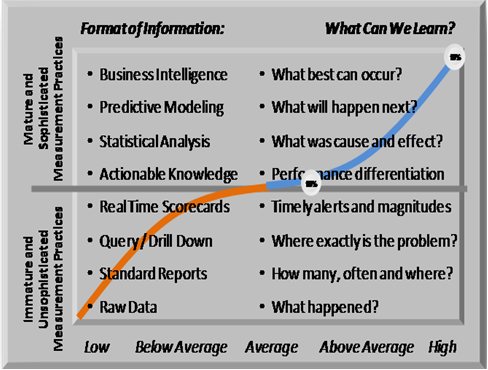
The chart above summarizes the degree of maturity and sophistication of an organization’s measurement practices. All healthcare organizations collect a lot of raw data but few really use the information to create a competitive advantage.
At the bottom of the ladder you have raw data, reams of information but very little actionable knowledge. The half way point on the sophistication ladder is actually creating real-time scorecards for every leader in every department. Our research reveals that about 90% of healthcare organizations are just now at the stage of creating real time scoreboards and scorecards. Most are collecting data for compliance purposes or to “keep score.” Few leaders can really say that they can quantify the cause and effect relationships between what their people do and the results they achieve.
At the top of the chart, you have real business intelligence that allows leaders to differentiate performance one leader at a time, understand what activities leverage the best outcomes, predict what might happen, and better predict (with odds of success) what can best occur with the decisions they make every day – every week – every month.
To download this article in a printable format, click here: Business Intelligence
Copyright (c) RPR2 and Success Profiles, Inc - All Rights Reserved

 |
 |
 |

BUSINESS INTELLIGENCE ::